Repairs · a guide, not a sales page
Garage door bottom seal replacement
The strip of rubber along the bottom of the door is the cheapest part of the whole assembly and the one that decides whether your garage stays dry. When it goes, water, grit, leaves and wildlife arrive together.
The short answer
In short.
A bottom seal slides into a retainer along the base of the door. Replacing it is one of the more approachable jobs on a garage door, with the door fully closed and nothing under tension involved.
The catch: a door that will not seal often does not need a seal. If the floor is uneven, the door is out of balance or the travel limits have drifted, a new strip will be crushed at one end and gaping at the other.
What the seal is, and what it is doing
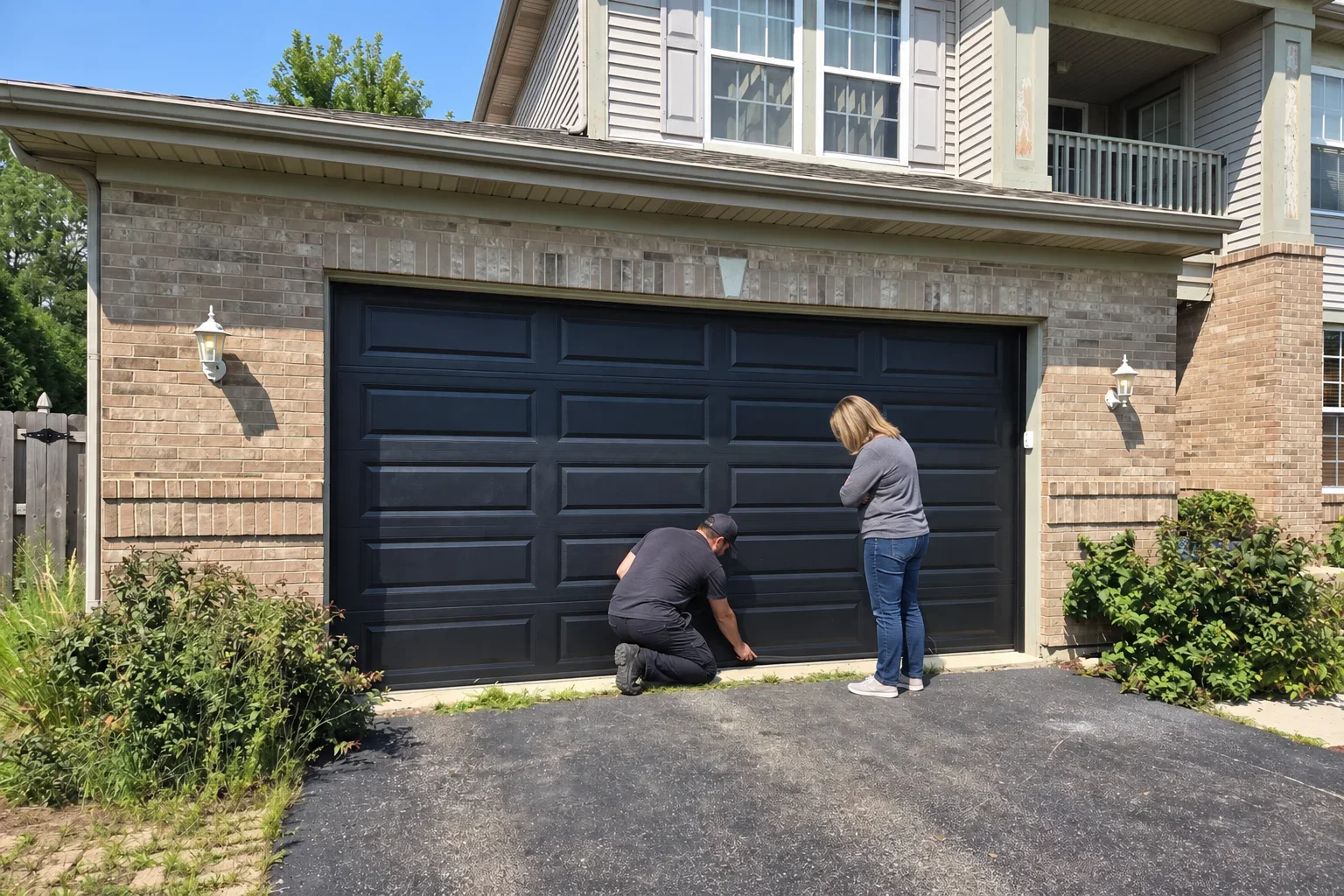
Along the bottom edge of the door there is an aluminium or steel retainer with a rubber or vinyl strip held in it. The strip squashes against the floor as the door lands, closing the gap between a straight door and a slab that is never quite flat.
It also takes the abuse. Sun, cold, rain, grit, a car tyre, a strimmer line. Rubber hardens and cracks, vinyl shrinks and tears, and the strip at some point stops touching the floor along its whole length.
Separately, the seals down the sides and across the top of the opening — the stop moulding — do the same job at the edges. They are a different part, and they fail differently.
How to tell whether it is the seal or the door
Close the door and look along the bottom from inside, with the garage light off. Daylight tells you most of what you need to know.
- Light in one thin even lineUsually a worn or shrunken seal. A straightforward replacement.
- Light at one end onlyThe door is not landing square, or the floor drops away. A new strip alone will not close it.
- Light in the middle, sealed at both endsOften a section that has bowed, or a seal that has pulled out of its retainer in the middle.
- The seal is crushed flatThe door is travelling too far down — a limit setting, and sometimes a symptom of something else.
- Water tracking in along one wallLook at the side seals and at the slope of the slab before blaming the bottom.
- Daylight at the top cornersThat is the stop moulding, not the bottom seal.
Free Estimates
5-Year Warranty on All Parts & Labor.Five years on parts and labor, every repair and every install. We look at the door with you first, and nothing starts until you approve the number.
Replacing it, if that is what it is
With the door fully closed, the strip slides out of the retainer at one end and the new one slides in the same way. The two things that catch people out are getting the right profile and getting the length right.
- Profile first. Retainers take specific shapes of strip, and a strip with the wrong bead will not stay in.
- Measure the door’s width and buy long, not short. Trim at the end.
- A little soapy water helps a stiff strip through the channel.
- Keep the door closed while you work, and do not lift it to get a better angle.
- Do not undo the bottom brackets at the corners of the door for access — that is where the lift cables anchor, and there is stored energy behind them.
If the retainer itself is bent, split or corroded, that is a different job, and it is worth having looked at rather than forced.
When it comes to us instead
A seal that keeps failing is usually reporting something else: a door out of balance landing heavily, a bowed section, a floor that has settled, or limits that push the door into the slab on every cycle.
A visit for a seal is also a visit that gets the safety check we do on every visit — auto-reverse tested, photo-eyes aligned, springs and cables inspected, door balanced — so the reason the seal failed gets found rather than replaced again next year. The number is on the written estimate first, and the invoice matches it.
Free Estimates · a person answers 24/7
5-Year Warranty on All Parts & Labor.Five years on parts and labor, every repair and every install. Call, or send the form and a person calls you back.
Sources
- Clopay — residential garage door service and support
- Raynor — garage door safety and care
- DASMA — Technical Data Sheets (Door & Access Systems Manufacturers Association)
All sources read . Linked so you can check them rather than take our word for it.
Written from the manufacturers’ own published guidance — every source is linked above.
Related reading
Where this goes next.
What you can count on
- Same-day service on most repairs.
- Upfront pricing. The price is on the estimate you approve before work starts, and the invoice matches it.
Straight answers
Questions people ask about this.
Can I replace the bottom seal myself?
Why does water still come in with a new seal?
The seal is crushed flat. Is that normal?
Do you charge to come out?
Describe it however makes sense to you
Read enough? Tell us about the door.
However you describe it is enough — no part names needed. The visit and the written estimate cost you nothing, and nothing starts until you approve the number.
- However you describe it is enough. No part names needed.
- The written estimate is free. Nothing owed if you pass.
- Nobody starts the repair until you approve the number.
Calls Answered 24/7
One call, and the door problem becomes ours.
A person answers 24/7. We look at the door with you first, and the written estimate comes before the work.