Commercial · sectional overhead doors
Commercial sectional overhead door repair in DFW
The door most service bays actually have.
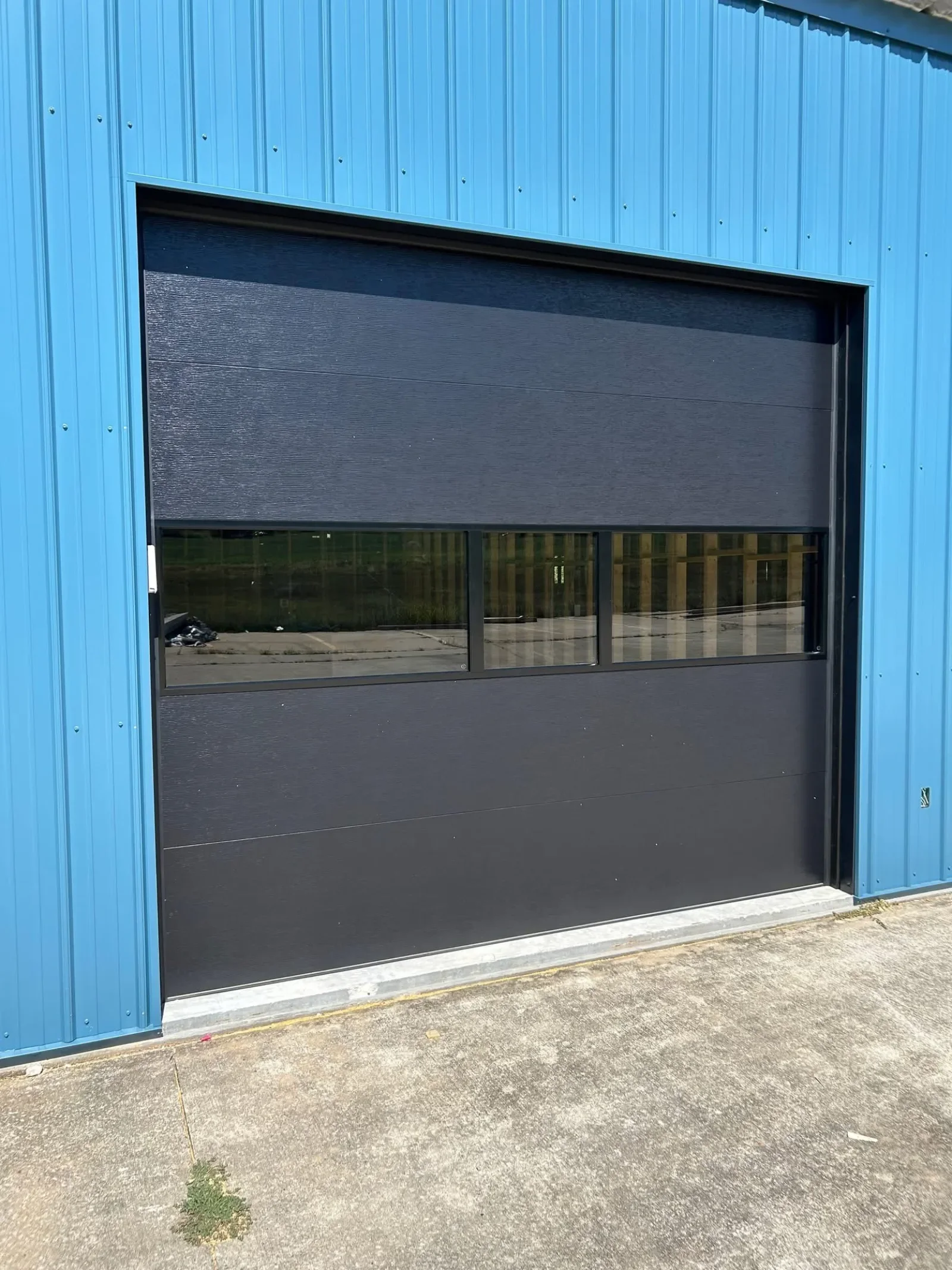
Sectional overhead doors on service bays, warehouses and docks: repaired and installed to the traffic the door carries, on a written estimate you can route for approval.
If the door is unsafe to use right now, a person answers 24/7.
What you can count on
- Same-day service on most repairs.
- Upfront pricing. The price is on the estimate you approve before work starts, and the invoice matches it.
What the door is
Sectional overhead doors, described plainly.
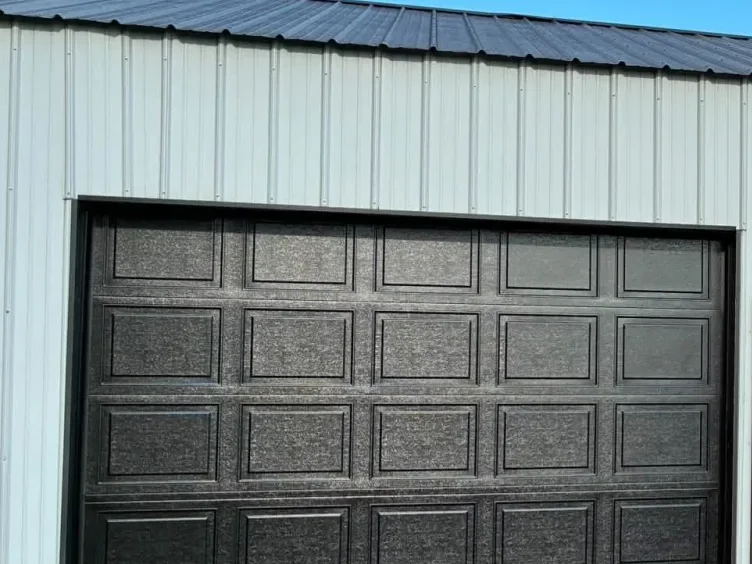
A commercial sectional door is the same idea as a residential one, built heavier: horizontal sections hinged together, rollers running in a steel track, and a counterbalance above the opening carrying the weight so the operator only has to move it.
What changes at a commercial opening is everything around that. The sections are thicker and heavier, the hardware is rated for far more cycles, the track arrangement is often high-lift so the door clears equipment, and the operator is a commercial unit with its own controls rather than a domestic opener.
Where it is usually working
- Service and repair bays Where the door cycles all day and every cycle is a vehicle waiting.
- Warehouse and yard openings Wide openings, often with a high-lift track to clear racking or a hoist.
- Fleet and municipal buildings Several identical openings, where standardized parts matter more than the look.
- Fire, ambulance and utility bays Openings where a door that will not open is the whole problem.
- Mixed-use and retail loading One or two bays behind a building, usually the least maintained doors on site.
What actually fails
The six things we are called out for.
Described the way a facilities manager sees them rather than by part number. If what your door is doing is not on this list, call and describe it — a person answers 24/7.
- Springs and cables The counterbalance is doing the work, and it wears by cycles. At commercial rates that arrives sooner than anybody plans for.
- Rollers, hinges and bearings Worn rollers mark the track, load the hinges sideways and eventually put a door out of true.
- Section damage Forklift contact, a trailer reversing, a dropped pallet. Often one or two sections rather than the whole door.
- Track and brackets A bent vertical track or a bracket pulled from the wall is what turns a bump into a door off its track.
- The operator Gears, boards, limits, and the safety devices around it.
- Bottom bar and seals A door that no longer seals at the floor lets in water, grit and everything that follows them.
Before you call
What to have ready so the estimate is right the first time.
A photo of each is enough.
- Opening and label Width between jambs, height from floor to header, and any model and serial number label inside the door.
- Clearance and track Headroom above the opening, room at each side, depth into the building, and the track: standard, low headroom, high lift or vertical lift.
- Operator type and age Drawbar or wall-mounted jackshaft, and how old. Entrapment rules differ for commercial operators made before and after August 2010.
- How it is used Cycles per day, long stretches held open, wash bays or chemicals, and anything added, like paint. DASMA, the door makers' association, says these affect spring life and door weight.
- What happened What hit it, and what it has done since. Clopay's commercial manual says running a door with damaged track could be hazardous; it says to call a professional promptly.
Rules and standards
The safety standards behind a powered commercial door.
What the standards ask of the door and its operator.
- UL 325 and the operator label UL 325 covers electric door operators. UL says the model building codes (IBC, IRC, IFC) require automatic garage door operators to be listed and labeled to it.
- Photo-eyes and edge sensors They signal the operator to stop or reverse. DASMA says UL 325 requires a commercial vehicle-door operator made after August 2010 to close only on constant pressure or to use a monitored device. Photo-eyes sit no higher than six inches above the floor.
- OSHA OSHA's 2002 letter says no OSHA standard is written specifically for overhead doors. DASMA says an operator can meet OSHA's electrical-equipment test by being listed and labeled by a recognized laboratory, under UL 325.
Upkeep rhythm
What the makers say to check, and how often.
These are the makers' intervals, not ours. Your door's manual decides.
- Every month Clopay says test the operator's safety reverse monthly. DASMA's photo-eye test: block the beam while closing, then with the door open. It should reverse, then refuse to close.
- Every two months Amarr says lubricate commercial door weather stripping with silicone-based lubricant, not petroleum-based oil, which costs it elasticity.
- Every six months Clopay and Amarr both call for an inspection twice a year. Clopay's list: cables, spring anchors, bearings, rollers, hinges, track alignment, fasteners. Adjusting is for a qualified mechanic.
- High-use doors Clopay says high-use doors need lubricating more often. DASMA says springs are maintained to the maker's written instructions, which helps maximize cycle life.
Sources
- DASMA — Technical Data Sheet 160, “Sectional Garage Door Terminology”
- Clopay — Installation & Maintenance: Commercial & Industrial Sectional Doors
- DASMA — Technical Data Sheet 1501, “Standard Lift Garage Doors with Jackshaft Operation”
- DASMA — Technical Data Sheet 382, “Proper Installation of Photoelectric Non-Contact Sensors on Vehicular Commercial Doors”
- DASMA — Technical Data Sheet 368, “Edge Sensors”
- UL Solutions — UL 325 50th anniversary and key safety issues
- OSHA — letter of interpretation, 10 September 2002, on standards for overhead doors
- DASMA — Technical Data Sheet 358, “Vehicular Commercial Door & Gate Operators and OSHA Requirements”
- OSHA — 29 CFR 1910.399, definitions applicable to the electrical subpart
- Amarr — How to maintain commercial garage doors
- DASMA — Technical Data Sheet 190, “Factors Affecting Spring Cycle Life”
- DASMA — Technical Data Sheet 151, “General Code Inspection Guidelines for Sectional Garage Doors”
- DASMA — Technical Data Sheet 351, “Federal and State Residential Garage Door Operator Legislation Guidelines for Dealers”
All sources read . Linked so you can check them rather than take our word for it.
What a visit involves
The estimate is the document you route.
A technician looks at the opening with you and writes the price before anything starts. Nothing begins until it comes back approved, and the invoice matches the number you approved.
- One opening or all of them Tell us which bay, and whether the others are due a look while a technician is on site.
- Scheduled around the dock Say which bays have to stay live and when the trucks run. A person answers 24/7.
- Safe before finished Where the work cannot be finished in one visit, we leave the opening as secure as it can safely be made and book the return.
- Standardized where it helps On a site with several identical openings, matching parts across them makes the next failure cheaper.
- 5-Year Warranty on All Parts & Labor. Five years on parts and labor, every repair and every install.
Describe it however makes sense to you
Tell us which opening, and when it has to run.
Tell us about the opening, the door and the traffic it has to carry. A technician measures on site, and nothing is ordered until the written estimate comes back approved.
- No spec sheet needed. The opening and how the dock runs are enough to start.
- The written estimate is free. Nothing owed if you pass.
- Nothing is ordered until the estimate comes back approved.
Calls Answered 24/7
Not this door?
The other commercial openings.
Each page says what that door type is, what fails on it, and what a visit involves. Or start at the commercial overview.
Questions people ask
Straight answers.
Is a commercial sectional door the same as a residential one?
Can one damaged section be replaced?
Can you standardize parts across our bays?
Can a wall-mounted operator go on standard track?
Can we raise the photo-eyes to protect trucks?
Do we need a photo-eye and an edge sensor?
What counts as a cycle?
Can our staff oil the door between visits?
Who tests the safety devices?
Are you insured?
How does approval work on a PO?
Do you charge to come out?
What does the warranty cover?
More answers on the questions page. Financing Available — how it works, in plain words.
Where we work
From Coppell, across DFW.
Every city on this map is a drive from our base in Coppell, for a house or a commercial building. Tap yours for the local page, or call — a person answers 24/7.
- Commercial garage door repair in Coppell
- Commercial garage door repair in Dallas
- Commercial garage door repair in Fort Worth
- Commercial garage door repair in Arlington
- Commercial garage door repair in Plano
- Commercial garage door repair in Frisco
- Commercial garage door repair in McKinney
- Commercial garage door repair in Denton
- Commercial garage door repair in Garland
- Commercial garage door repair in Irving
- Commercial garage door repair in Lewisville
- Commercial garage door repair in Flower Mound
- Commercial garage door repair in Carrollton
- Commercial garage door repair in Grapevine
- Commercial garage door repair in Southlake
- Commercial garage door repair in Keller
- Commercial garage door repair in Richardson
- Commercial garage door repair in Allen
- Commercial garage door repair in Mesquite
- Commercial garage door repair in Addison
- Commercial garage door repair in Farmers Branch
- Commercial garage door repair in Euless
- Commercial garage door repair in Colleyville
- Commercial garage door repair in The Colony
- Commercial garage door repair in Highland Village
- Commercial garage door repair in Trophy Club
- Commercial garage door repair in Hurst
- Commercial garage door repair in North Richland Hills
- Commercial garage door repair in Celina
- Commercial garage door repair in Bedford
- Commercial garage door repair in Westlake
- Commercial garage door repair in Las Colinas
- All service areas
Free Estimates. A person answers 24/7.
Tell us what the door is doing. The visit and the written estimate are free, nothing starts until you approve the price, and most standard repairs are paid after the work is done.