Repairs · a guide, not a sales page
When does door weatherstripping need replacing?
A seal fails long before it looks broken. It goes hard, it flattens where it has been squeezed for years, and it stops touching the door — and the first thing most people notice is the draft, not the strip.
The short answer
In short.
Shut the door and look along each edge on a bright day. Light means air. A seal that has gone hard, flattened or pulled out of its channel is a small job. A door that has dropped, or a frame that has moved, is a different job — and a new seal on a door that no longer meets its stop is money spent on the wrong part.
What weatherstripping actually is
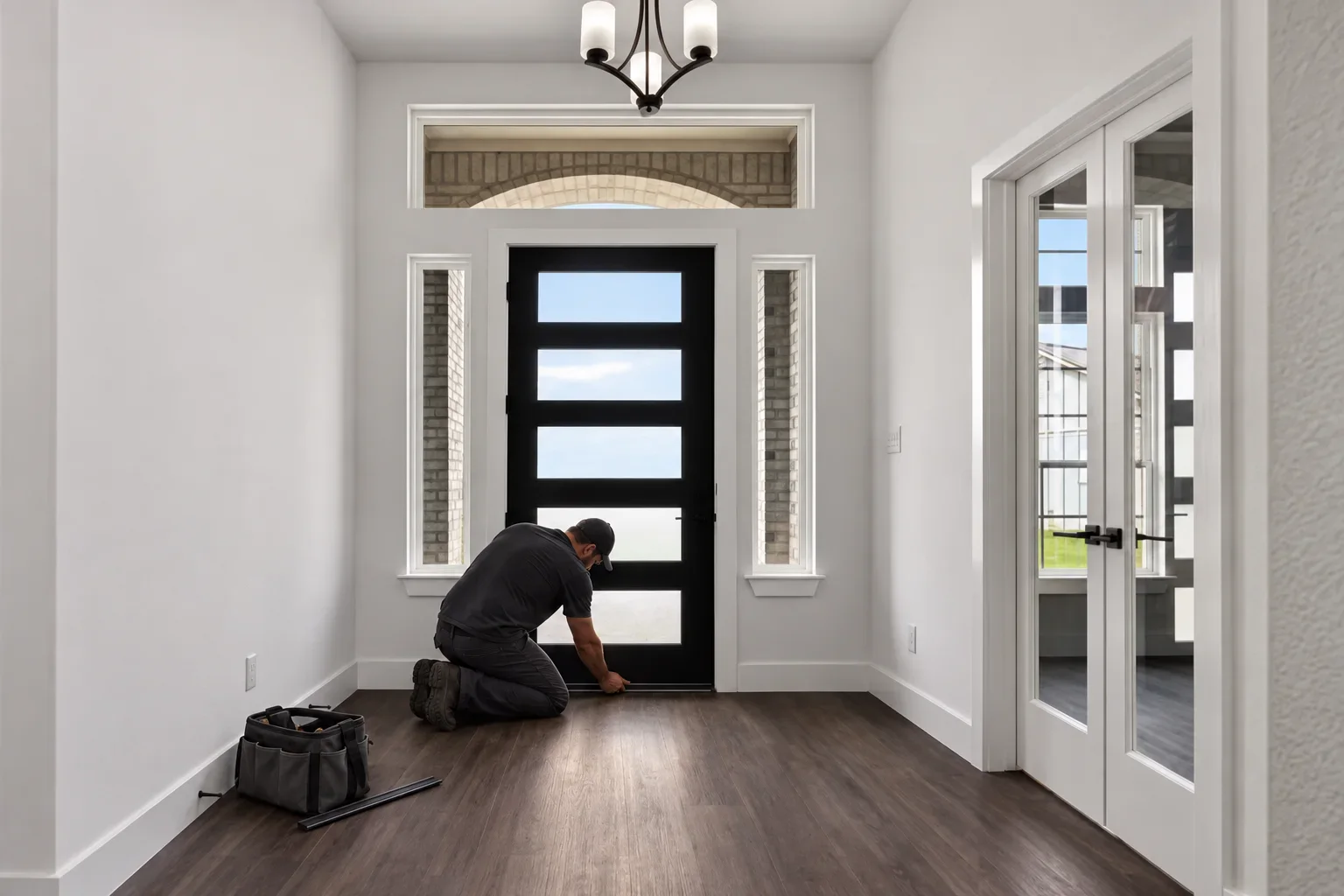
It is the seal between a door and the frame it closes into: the strip set in the jamb on the two sides and the head, and the sweep along the bottom that meets the threshold. It works by compression — the door presses against it when the latch catches — which is why a strip that has flattened stops working while still looking present.
The bottom edge is the hardest of the four, because the gap it has to close moves. The slab and the floor shift a little with the seasons, which is why many thresholds have adjusting screws under a cap.
How to tell it has gone
Three checks, none of which need a tool.
- Look for daylightShut the door, stand inside on a bright day, and look along the latch side, the hinge side, the head and then the bottom corners. Light means air.
- Try a slip of paperClose the door on a sheet of paper and pull. Drag means the seal is meeting; if it slides out freely, nothing is touching at that point. Repeat it at the top, the middle and the bottom of each side.
- Feel the strip itselfPress it with a thumb. A live seal springs back. One that has gone hard, or that stays squashed, has stopped doing the work.
- Listen to the doorA door that used to shut quietly and now thuds is often closing onto a flattened seal rather than a live one.
The bottom corners are where a sweep gives up first, so they are worth checking even when the rest of the edge looks fine.
Free Estimates
5-Year Warranty on All Parts & Labor.Five years on parts and labor, every repair and every install. We look at the door with you first, and nothing starts until you approve the number.
What is on the door, and where
Along the jamb, a strip set into a groove — the kerf — on the two sides and the head. At the bottom, a sweep fixed to the slab that meets a threshold fixed to the floor. On a storm door, the same idea plus its own sweep.
The Department of Energy’s weatherization job aid for an exterior door describes the order the work is done in: measure each side of the doorway to size the strip, notch the ends of the side pieces where the manufacturer has not, bed the strip on a thin bead of caulk, fasten it with the short screws supplied, then check the door runs smoothly and adjust as needed.
When a new seal will not fix it
This is the part worth knowing before you buy a strip. A seal can only close a gap that is the same size every time the door shuts. If the door has dropped on its hinges, if the frame has moved as the house settled, or if the latch no longer pulls the slab up to its stop, the gap changes along the edge — and no strip closes a gap that is wide at the top and tight at the bottom.
The same job aid puts it in the order of work: adjustments to the door — loose hinges, knobs, strike plates and the like — are made **before** the weatherstripping goes on. A strip fitted to a door that is out of line is fitted to a moving target.
So the sequence is: make the door close the same way every time, then seal it. Done the other way round, the new strip wears in the same place the old one did.
Doing it yourself, or having it looked at
Replacing a jamb seal is often a homeowner job, and the search volume says plenty of people treat it as one. Nothing here argues otherwise.
What a visit adds is the check above it: whether the door hangs true, whether the threshold still meets the sweep, and whether the frame is sound where the strip screws into it. If the answer is that the door needs setting right first, that is worth knowing before the strip goes on rather than after.
Where our line is
Two things we do not take on, so nobody waits on us for them: broken or fogged glass and insulated-glass units, and solar screens. On a new unit we attach, adjust and test the latch the manufacturer supplied, and nothing beyond that.
Free Estimates · a person answers 24/7
5-Year Warranty on All Parts & Labor.Five years on parts and labor, every repair and every install. Call, or send the form and a person calls you back.
Sources
All sources read . Linked so you can check them rather than take our word for it.
Written from the manufacturers’ own published guidance — every source is linked above.
What you can count on
- Same-day service on most repairs.
- Upfront pricing. The price is on the estimate you approve before work starts, and the invoice matches it.
Straight answers
Questions people ask about this.
How often should weatherstripping be replaced?
Can I just add a second strip over the old one?
The draft is at the bottom only. Is that the sweep?
Do you do this on windows too?
Describe it however makes sense to you
Read enough? Tell us about the window or door.
Tell us which window or door it is and what you want done, even if you don’t know what anything is called. This starts a conversation, not an appointment.
- However you describe it is enough. No part names needed.
- The written estimate is free. Nothing owed if you pass.
- Nothing is ordered or started until you approve the number.
Calls Answered 24/7
One call, and the window or door is ours to sort out.
A person answers 24/7. A technician measures the opening with you first, and the written estimate comes before anything is ordered.