Buying guide · a guide, not a sales page
How much does a garage door weigh?
It varies widely, and the size alone will not tell you. Two doors filling the same opening can differ a great deal, and the counterbalance is matched to the actual door.
The short answer
How heavy is a garage door? The short answer
There is no single weight for a garage door, and its size alone will not give you yours. Published figures put most modern single steel doors around 125 pounds and most double doors around 200 (The Genie Company, an opener maker), and DASMA, the industry association, says garage doors can weigh anywhere from 90 pounds to over 500. The classic double is 16 feet wide by 7 feet high (Clopay), and material, layers, insulation, windows, reinforcement, the finish and the hardware all move the number.
The published figures are ranges for doors in general, not your door’s number. That number comes from whoever made or installed it, in writing, or from a technician measuring it safely on site. The springs are sized to that number, not to the size of the opening. The sizes doors come in are a separate question from what they weigh.
Published figures
What DASMA and door makers say a garage door weighs
Here is each figure as its publisher prints it, with the publisher named. Nothing is averaged, and none of them is the weight of a particular size or model.
| Door described | Figure as published | Published by |
|---|---|---|
| Any garage door | 90 pounds to over 500 pounds | DASMA, the trade group: data sheet 176 |
| Single door, most modern steel | Around 125 pounds; older and wooden doors weigh much more | Genie, an opener maker: blog, February 2022 |
| Single door | 150 pounds on average, and at least 130 pounds | Garaga, a door maker: blog, March 2020 and May 2015 |
| Single-car door, upper figure | As much as 200 pounds | Clopay: install manual, the step for removing the old door |
| Double door, most | Around 200 pounds | Genie: blog, February 2022 |
| Double door with windows | Up to 350 pounds or more | Garaga: blog, May 2015 |
| Modern all-glass double door | Over 400 pounds | Garaga: blog, May 2015 |
| Large door, upper figure | As much as 500 pounds | Clopay: install manual, the step for removing the old door |
These are published figures for particular kinds of door, not a rule, and not weights we measured. Publishers differ: Haas Door says in its residential installation manual that a door can weigh up to 600 pounds, and a Chamberlain Group support article says garage doors can weigh from a couple hundred pounds to a thousand. The label identifies the door; its maker gives its weight.
What changes the weight
- What it is made of Steel, aluminum, composite, wood — and in wood, which wood.
- How many layers A single skin, or a layered section with insulation and a backing.
- Windows Glazing is heavy, and where it sits changes the balance as well as the total.
- Reinforcement Struts and wind reinforcement add real weight, and they are often invisible from outside.
- The finish Overlays and applied cladding are not free.
- Hardware Track, hinges, rollers and brackets differ by design and by duty.
Free Estimates
5-Year Warranty on All Parts & Labor.Five years on parts and labor, every repair and every install. We look at the door with you first, and nothing starts until you approve the number.
Why an estimate is not good enough for spring work
The counterbalance is calibrated to a specific door. Springs sized from a guess will either not lift the door or will fight it, and either one wears the system and the opener while it does so.
This is the single reason it is worth knowing rather than assuming. It is not a detail; it is the specification the whole system is built around.
DASMA’s technical sheet on adding weight to a garage door says door springs are designed to accommodate the door’s original intended weight, and that weight added afterwards could leave the door unbalanced, possibly even damaging or breaking the springs. It strongly advises against untrained individuals attaching anything to a door without explicit instructions from the door’s maker. How long springs then last is its own question: how long garage door springs last.
How to find the real number
- Look for the manufacturer’s label or the paperwork that came with the door
- Take the model or series name from it, not just the brand
- Ask the maker, or whoever installed the door, for that model’s weight in writing
- If there is no label and nobody can say, a technician measures it properly on site
Where the line is
Do not try to weigh a door by disconnecting a spring, a cable or anything else holding it up. That is not a measurement, it is a release of stored energy with somebody standing under it.
Spring and cable work belongs to somebody trained for it. DASMA’s sheet on checking a door says only trained door systems technicians should remove, repair or adjust doors, springs or anything they are fastened to, and Amarr’s FAQ says not to attempt to remove, repair or adjust springs or cable.
Weight and springs
How springs are matched to weight, and what changes it
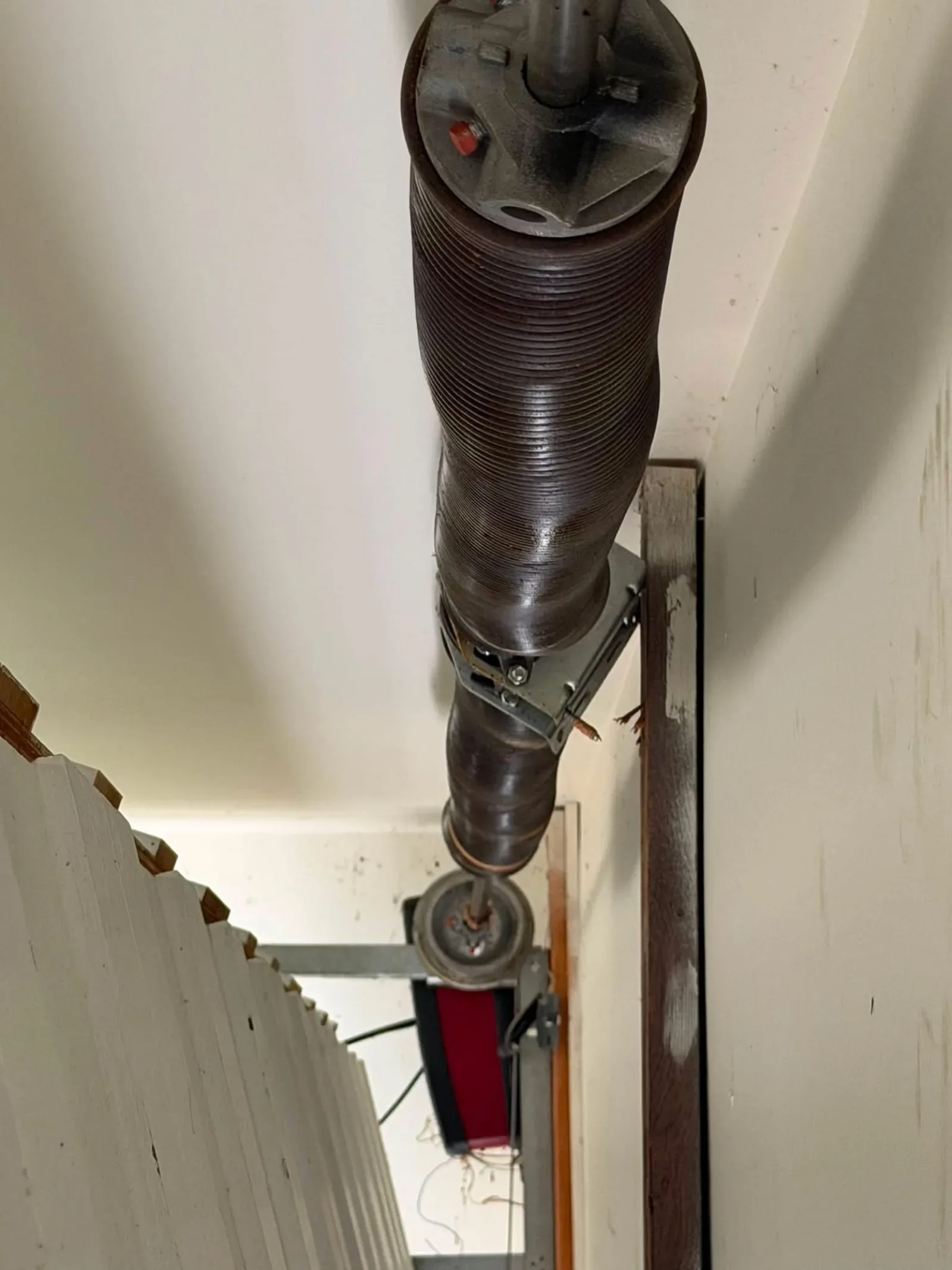
Springs are matched to a specific door. C.H.I. describes the springs on its model 2250 and 4250 residential doors as custom designed for exact door weight, size and trajectory, and DASMA’s official color code for extension springs is keyed to door weight in 10-pound steps. DASMA warns that not knowing whether a spring meets a door’s counterbalance requirement can shorten the life of the door and its opener’s motor, and could create a safety issue in manual operation. That is why the ranges above cannot pick a spring for you.
The weight can also change after the door is built. DASMA’s sheet on spring life says that paint or components added by a building occupant may push a door past the weight its maker specified, and that where paint appears to be adding weight, a trained door systems technician may measure the effect with a scale once the counterbalance has been disabled. Amarr’s installation instructions say that adding a strut to a door that came without one changes its weight and that different springs may be required. If your door has been painted or had parts added since it was installed, say so before a spring is chosen.
Free Estimates · a person answers 24/7
5-Year Warranty on All Parts & Labor.Five years on parts and labor, every repair and every install. Call, or send the form and a person calls you back.
Sources
- DASMA — Technical Data Sheet 176, “Adding Weight to a Garage Door Assembly”
- DASMA — Technical Data Sheet 174, “Building Occupant – Checking a Residential Sectional Garage Door for Damage”
- Amarr — residential garage door FAQs
- Clopay — “What is the Average Garage Door Size?”
- DASMA — TDS 171, official color codes for torsion and extension springs
- DASMA — TDS 190, factors affecting spring cycle life
- The Genie Company — best openers for heavy doors (blog, February 2022)
- Garaga — how to fix garage door cables safely (blog, March 2020)
- Garaga — how to take the headache out of a heavy garage door (blog, May 2015)
- Clopay — installation instructions, residential sectional insulated steel doors (INST-4150077)
- Clopay — installation instructions, residential sectional 1-layer and 2-layer doors (INST-4150078)
- Clopay — installation instructions, residential sectional wood doors (INST-4150079)
- Clopay — installation instructions, residential sectional aluminum doors (INST-4150080)
- Clopay — installation and maintenance, residential aluminum Sleek sectional doors (INST-4152629)
- Amarr — installation instructions, residential steel garage doors
- C.H.I. Overhead Doors — residential specification sheet, models 2250 and 4250
- Haas Door — residential installation and owner’s manual (dealer-hosted copy)
- Chamberlain Group — introduction to residential garage doors
Sources 1 to 4 read , except DASMA sheets 174 and 176, read ; sources 5 to 18 read . Linked so you can check them rather than take our word for it.
Written from the manufacturers’ own published guidance — every source is linked above.
Related reading
Where this goes next.
What you can count on
- Upfront pricing. The price is on the estimate you approve before work starts, and the invoice matches it.
Straight answers
Questions people ask about this.
How heavy is a basic double-wide garage door?
How heavy is a 7 ft garage door?
Can the size alone tell me the weight?
Where do I find my garage door’s weight?
Why does the weight matter?
Should I try to weigh it myself?
Does insulation add weight to a garage door?
Describe it however makes sense to you
Read enough? Tell us about the door.
However you describe it is enough — no part names needed. The visit and the written estimate cost you nothing, and nothing starts until you approve the number.
- However you describe it is enough. No part names needed.
- The written estimate is free. Nothing owed if you pass.
- Nobody starts the repair until you approve the number.
Calls Answered 24/7
One call, and the door problem becomes ours.
A person answers 24/7. We look at the door with you first, and the written estimate comes before the work.