Repairs · a guide, not a sales page
What to do when a garage door comes off track
Stop, look, report.
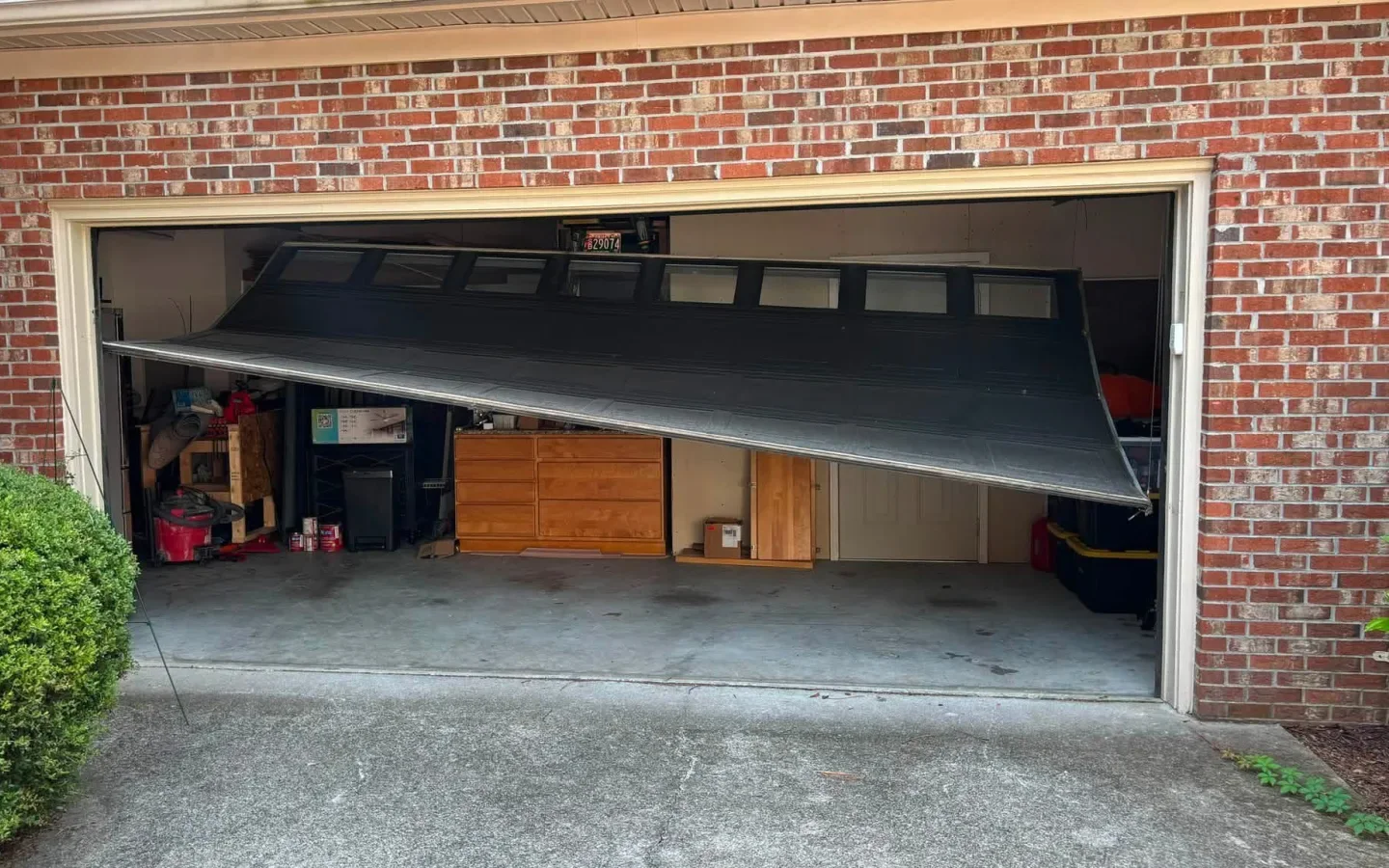
A door hanging crooked in its opening is still under spring tension, and the rollers are what is holding it there. Here is what is safe to do while you wait, and what to tell us on the phone.
The short answer
Garage door off track: the short answer
Stop using the opener. Get everyone out from under the door. Look from a safe distance, write down what you can see, and call. Nothing about an off-track door is a five-minute fix from the driveway, and the two minutes you spend looking will make the visit shorter.
Stop operating the door
Wall button, remote, keypad, app — all of it. A door that is already out of its track moves things that are not meant to move, and every cycle after the first one tends to make the repair bigger rather than smaller.
Do not stand under it and do not try to guide it by hand. DASMA, the manufacturers’ own association, treats a garage door as a large moving object under stored tension, which is exactly what it is.
Keep the area clear
People, pets and cars out of the opening. Do not park under a door that is hanging, and do not walk under it to get to the car.
If a car is trapped behind it, tell us on the phone — it changes how we dispatch. Do not force the door up to get the car out. The emergency page has the line.
Do not touch a loose cable, and do not loosen the bottom brackets at the corners of the door. That is where the lift cables attach, and there is stored energy behind them.
- If the door is hanging and something is holding it up, stay out of the garage entirely
- If it has shifted since you first looked, move away and call from outside
- If anyone is hurt, call emergency services first and us second
Free Estimates
5-Year Warranty on All Parts & Labor.Five years on parts and labor, every repair and every install. We look at the door with you first, and nothing starts until you approve the number.
What you can see without touching anything
From outside the door’s path, standing to one side. Any of these is worth a photograph and worth saying on the phone.
- One side higher than the other The clearest sign that a cable has come off a drum or a roller has left the track.
- Rollers out of the track Look along both vertical tracks from a distance, not from underneath.
- A slack or dangling cable A cable that is no longer tight, or one that has come off its drum above the door.
- A gap in the spring above the door On most doors the spring runs along a shaft above the opening. A visible gap in the coil means it has broken.
- Something hit it A car, a trailer, a mower. Say so — it changes what we look at first.
- A loose track bracket A bracket pulled away from the wall or the ceiling.
- A folded, cracked or separating section Panels that no longer line up with each other.
Why “just put it back” goes wrong
The track only guides. What actually carries the door is the counterbalance: springs hold the weight, cables transfer it, drums keep the cables where they belong, and brackets anchor the whole thing to the building.
Move one of those without understanding the rest and you either release stored energy or let the door drop on one side. DASMA’s own guidance is that spring, cable and counterbalance work belongs to a trained technician, and it is the same line we hold. Off-track door repair is that work, and cable repair covers a cable that has come off its drum.
The right order is: take the tension off, put the door back on its rollers, then find out what put it off the track in the first place. Skipping the last step is why some doors come off twice.
What to put in the request
- The address and whether it is a home or a site A facility gets scheduled around the bays that have to stay open.
- Roughly how wide the door is A single or a double is enough. If you know it is taller than standard, say so.
- What the opener is doing Nothing, running and straining, or you have not touched it since.
- What you think happened Even “I have no idea” is useful — it rules things out.
- Two photographs One of the whole opening from a safe distance, one of the roller or track area. Not a close-up that puts you under the door.
Free Estimates · a person answers 24/7
5-Year Warranty on All Parts & Labor.Five years on parts and labor, every repair and every install. Call, or send the form and a person calls you back.
Sources
- DASMA — Technical Data Sheet 174, “Building Occupant – Checking a Residential Sectional Garage Door for Damage”
- Amarr — residential garage door FAQs
Sources read , except DASMA sheet 174, read . Linked so you can check them rather than take our word for it.
Written from the manufacturers’ own published guidance — every source is linked above.
What you can count on
- Same-day service on most repairs.
- Upfront pricing. The price is on the estimate you approve before work starts, and the invoice matches it.
Straight answers
Questions people ask about this.
Can I run the opener if the door is off track?
Should I run the door once to see what happens?
Can I push the roller back in?
What if my car is stuck behind it?
Describe it however makes sense to you
Read enough? Tell us about the door.
However you describe it is enough — no part names needed. The visit and the written estimate cost you nothing, and nothing starts until you approve the number.
- However you describe it is enough. No part names needed.
- The written estimate is free. Nothing owed if you pass.
- Nobody starts the repair until you approve the number.
Calls Answered 24/7
One call, and the door problem becomes ours.
A person answers 24/7. We look at the door with you first, and the written estimate comes before the work.